

For the first 15 years of my incarceration in Massachusetts, I didn’t have much contact with health services. I had heard horror stories, especially after the private provider Wellpath took over the state’s corrections healthcare in 2018, so I was thankful that I rarely needed anything beyond checkups. But my luck ended in 2020. That’s when I started a slow, painful and endlessly frustrating health journey that still has me wondering if I am going to live or die.
My deterioration started that January with a slight weakness in my right leg that was soon followed by twitching and cramps. In mid-February, I woke up with a thigh cramp so severe that it felt like the muscle was being unzipped. I submitted my first sick call request form that day.
A Wellpath nurse practitioner examined me at the health services building a few days later. I remember her saying that my symptoms were likely due to a small mass in one of my pelvic lymph nodes — which a doctor had discovered during an annual check-up the previous November — and referred me to oncology. As far as I knew, Wellpath hadn’t yet scheduled an appointment with an oncologist. Because the growing weakness in my leg caused me to stumble, Wellpath issued me a cane in May.
In July, after COVID-19-related delays, I saw an oncologist at Boston Medical Center. He seemed comfortable that the mass in my lymph node was likely benign, and it was eventually removed. But the mass didn’t explain my symptoms, which by then had become so severe that my cane was replaced with a rolling walker. The oncologist said that I might have a potentially serious neurological condition and needed to talk to a specialist right away.
I saw a Boston Medical neurologist and neuromuscular specialist — via telemedicine — later that month. He said I needed to come in and would request that Wellpath send me into the clinic as soon as possible.
But over the next four months, Wellpath failed to schedule an appointment. Its health services administrator told me that the clinic wasn’t accepting appointments because of COVID-19. But the clinic told my lawyer that they had repeatedly requested that I come in. I believed the clinic.
During this impasse, Wellpath stopped responding to my sick call request forms. I submitted more than a dozen about my growing symptoms, which included weakness in my trunk that made it difficult to sit up, weakness in my throat that made it hard to eat, and injuries from falls.
One Year in, Even More Delays
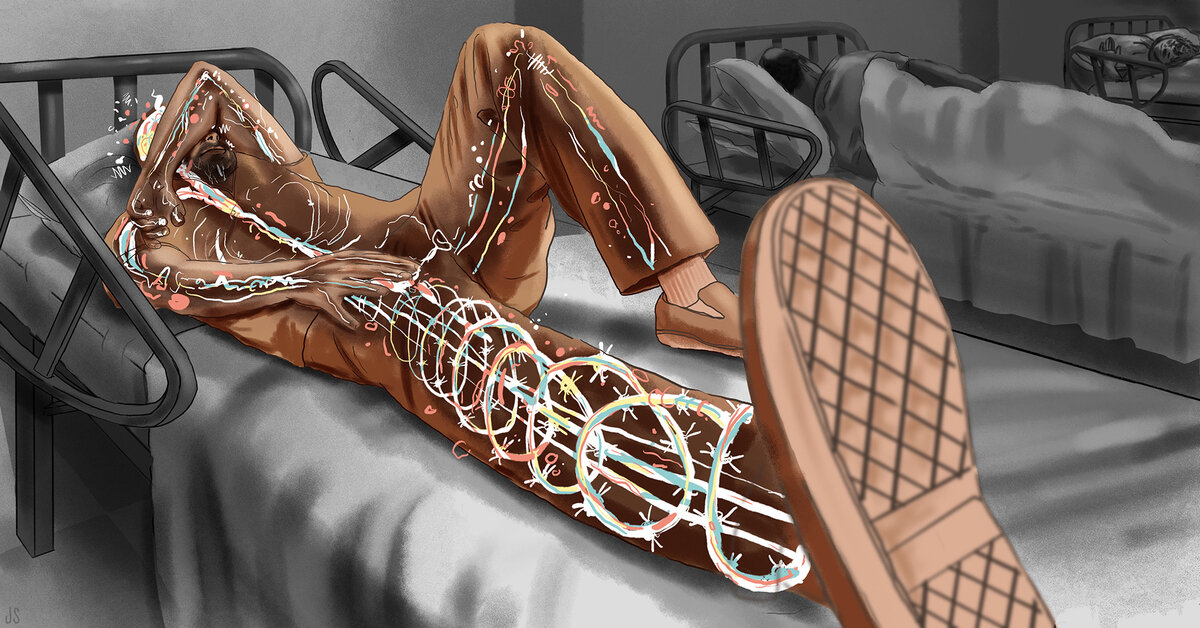
When a Wellpath doctor saw me at the prison in February 2021, I could barely stand. I spent most of my days in bed. I could no longer write clearly or shave safely, and I found it increasingly difficult to chew and swallow food.
The Wellpath doctor took my condition seriously enough to submit an immediate referral to neurology and transfer me to the prison’s medical unit, called the Clinical Stabilization Unit.
There, I became one of over a dozen patients crammed into a small open dorm divided into four sections. Our beds were about five feet apart. Two dingy bathrooms, a shower room, a nurse’s station, and an officers’ station rounded out the tiny space.
Even after being transferred to the medical unit, and undergoing two MRIs in April, I didn’t see a neurologist in person until June. That visit might not have happened if Prisoners’ Legal Services of Massachusetts didn’t write letters to the corrections department and Wellpath on my behalf.
Dueling Opinions, Zero Answers
In June 2021, after undergoing more testing, a Boston Medical neurologist determined that I was suffering from a progressive neurodegenerative disease. He speculated that it could be ALS (also known as Lou Gehrig’s disease), a deadly disease that attacks the nerves in the brain and spinal cord that control voluntary movements like walking, talking and chewing. He said that PLS, a similar but less fatal neurological disease, was also a possibility. He referred me to a clinic that specializes in ALS.
Another three months passed before Wellpath sent me to the ALS Multidisciplinary Clinic at Massachusetts General Hospital in Boston. At that September appointment, a neurologist reviewed my medical history, examined me, and said she was “not confident” that I had a diagnosis of ALS or PLS. She said that if ALS was ruled out, and if I didn’t have another kind of nerve problem called sciatica, I could be suffering from a “functional neurological disorder (FND).”
FND is a lesser-understood condition that may be triggered by stress or trauma. Because it has a psychological component, she said I had to be diagnosed by someone who specialized in mind-body disorders. She ordered more tests, recommended that I be evaluated at Mass General’s Benson-Henry Institute for Mind Body Medicine, and told me to come back to see her again in two to three weeks.
I was relieved to hear the news that my condition might be something other than deadly ALS, but that was short-lived: When I met with the prison medical director the next day, he shared concerns with the notes from my appointment at the ALS clinic.
He pointed to what he called “conflicting impressions.” For instance, while I was wheelchair-bound and had trouble moving without help, the neurologist at the ALS clinic had written that I demonstrated full muscle strength. He also said her notes lacked critical details.
Despite the conflicting opinions and the possibility of missing information, Wellpath did not send me to the Benson Henry Institute or anywhere else to be evaluated for FND. They also failed to return me to the ALS clinic two to three weeks later, as the neurologist there had requested.
Only after more advocacy from Prisoners’ Legal Services did Wellpath return me to the ALS clinic. The neurologist repeated what she’d said the previous September: She didn’t think I had ALS.
A Surprise in Court
Over the next nine months, my symptoms progressed, albeit more slowly than the previous year. A familiar pattern set in. I would make requests to see a neurologist who could tell me, definitively, what was making me sick. Wellpath would deny my requests, triggering more advocacy on my behalf from Prisoners’ Legal Services.
Finally, in October 2022, I had an appointment with yet another neurologist, this time at UMass Memorial Medical Center. To my surprise, I didn’t receive an official diagnosis or next steps in my care because Wellpath had only asked the new neurologist to review my records. The new doctor concurred with her predecessor and gave no further guidance.
The limited scope of the UMass appointment seemed odd to me. That is, until I went to court in March 2023 for a medical parole appeal. The department of corrections argued that my petition should be denied because my records suggested that I had FND — a condition the department described as “psychosomatic,” or psychological in nature.
The attorney went on to imply that there might not be anything physically wrong with me since I had “a history of engaging in deception,” referring to the first-degree murder conviction I received in 2008. (Authorities accused me of slowly poisoning my wife without her knowledge; I maintain my innocence.) Unsurprisingly, the judge denied my petition, and I was transferred to the medical unit of another prison, MCI-Shirley. Officials told me that I had been moved because I needed a higher level of care.
A Never-ending Nightmare
As I write this, it has been about 10 months since I last saw a neurologist, and I do not know when I will next see one. I am still wheelchair bound and require special padding and straps to hold me upright. I need oxygen throughout the day and a ventilator at night. I am also on a highly specialized diet, and I have to wear a cuff on my hand to help me hold eating utensils. I may eventually need a feeding tube.
I still have no formal diagnosis beyond “progressive neurological disorder,” which means that I am not being treated. This medical unit at MCI-Shirley is even smaller than the one at MCI-Norfolk. In one breath, the department of corrections tells me I need to be here because of how my condition is progressing; in the next breath, they imply that there is nothing really wrong with me.
So I may be dying of ALS. Or deteriorating due to PLS. Or suffering from FND. Or something else. Even worse than not being able to walk and struggling to eat and breathe is not knowing what’s wrong with my body. I fear that through all these delays, requests and conflicting opinions, the doctor who will finally diagnose me will be the coroner.
James Keown is a writer and former radio host serving life without parole for murder in Massachusetts. A version of this essay was previously published by Deeper Than Water. The Marshall Project has independently fact-checked and edited the content, and we are not affiliated with Deeper Than Water.
When asked about Keown’s experience and general questions about Wellpath and medical units, the deputy director of communications for the Massachusetts Department of Corrections directed The Marshall Project to Wellpath regarding medical questions, and stated they “cannot speak to the specifics of an individual’s incarceration or their medical issues without the individual’s CORI and/or HIPAA waivers.” When contacted with similar questions, Wellpath did not respond by publication time.