

A book is not always just a book. Volunteers who mail books to people in prison said they see proof of that in the requests they get every day. A sign language dictionary for a man whose child was losing their hearing meant connection to family. Books for a woman taking a course behind bars was her path to a degree. A Buddhist workbook was comfort for a man on death row.
But fulfilling these requests is becoming more difficult in some states because books represent something else for prison officials: a way to smuggle in drugs. In recent years and months, states including Iowa, Missouri and Texas have cracked down on who can send books, citing concerns over narcotics-laced paper. And prisons across the country are rejecting books because they argue that stains, packaging materials or stickers on the pages could contain dangerous substances.
The Marshall Project has documented more than 50,000 records of publications dating back to the 1990s being banned by state prisons that censor materials containing sexual content, references to racial justice or other topics corrections staff deem inappropriate, or threats to security. But free speech advocates and groups that promote reading in prison say the increased crackdowns that limit who can mail books inside amount to harmful, de facto book bans while doing little to help prevent overdose deaths behind bars.
Moira Marquis, a senior manager at PEN America, an organization that advocates literary and journalistic freedom, has been researching access to books in prison. She said these policies that bar books based on their origin or how they are mailed rather than their content are growing and threaten incarcerated people’s right to access books and information. Based on calls to prison mailrooms in 16 states, PEN America found more than 80% of those state and federal correctional institutions now dictate that literature come from approved vendors, according to a report to be released this October.
“Absolutely [these policies] are censorship,” she said. “This is depriving people from being able to acquire information.”
Marquis said she is even more concerned about these restrictions than banned books lists, because of the huge number of titles that could be affected. She said many states do not track how many books are rejected because of limits on vendors or how the book is mailed. According to PEN America’s forthcoming report, Idaho provides an example of the potential scale of the issue. In a yearlong period starting in August 2021, Idaho rejected 2,079 individual books that did not come from an approved vendor. Idaho, which incarcerates roughly 8,000 people in its prisons, has 10 approved book vendors, and a department spokesperson said the policy is a reasonable response to a growing problem that threatens safety and security.
Other states have made similar changes. In Iowa prisons, books can only come from two approved vendors, a policy adopted in 2021 according to local news reports. But those vendors have limited selections. For example, Ralph Ellison’s classic book “Invisible Man,” which explores issues of racism and Black identity, is not available from either vendor, despite being a key piece of the U.S. literary canon.
Eric Strenge has been incarcerated for nearly 17 years and said book access in Iowa prisons is “getting worse and worse.”
“I think a lot of it’s due to the political climate today … it’s really made the prison staff and administration more bold to enact stricter policies,” Strenge said, adding, “I mean, years ago, this would have been unthinkable.”
The Iowa Department of Corrections didn’t respond to multiple emails and calls with questions.
In September, Missouri banned individuals and organizations from sending books to people in prison, or even purchasing them on someone’s behalf. Instead, incarcerated people must purchase books themselves. A coalition of prisoner rights groups called this a de facto book ban because incarcerated people have limited access to money. Some job assignments in Missouri prisons, for example, pay 81 cents an hour.
Karen Pojmann, a spokesperson for Missouri Department of Corrections, said the department implemented the rule after mailroom staff found paper soaked with drugs such as methamphetamine. “We are trying to save lives,” she said.
Pojmann was unable to provide data on the total number of overdose deaths in Missouri prisons in recent years. But deaths from drug overdoses have been plaguing prisons and jails. According to data from the U.S. Department of Justice, 253 people died in prisons nationwide from drug or alcohol intoxication in 2019, a significant increase from 2001 when that number was 35 people.
Dylan Pyles is a co-founder of Liberation Lit, which until recently sent books to people in Missouri prisons. He said the department is using books as a scapegoat.
“It sounds nice. It sounds like you’re taking action on an issue. But the Department of Corrections has, to this day, still failed to provide us any concrete data or verifiable evidence that the contraband is coming in through the mail or the books at a rate that would truly affect and influence the rising number of deaths in the facilities,” Pyles said.
Missouri officials also declined to provide The Marshall Project documentation or data on contraband drugs smuggled in through books.
“We really don’t know what the primary source is because often drugs aren’t found until they’re already inside the facility, at which point it can be difficult to trace the origins,” Pojmann said. She also pointed toward an increased use of drugs in liquid form, which can be difficult to detect and easy to smuggle.
But Pyles said prison staff, rather than nonprofit book groups, are a more likely source of contraband. The director of the Missouri Corrections Officers Association told the Jefferson City News Tribune that he supports mail restrictions, even though prison prison staff are a primary source of drugs and smuggling through mail is minimal. In April, police arrested a correctional officer for allegedly smuggling drugs into a facility where there had been overdose deaths.
There is evidence from other states that guards are a source of drugs and other illegal contraband. Since 2018, there have been at least 360 cases of staff smuggling contraband, including drugs, into Georgia state prisons, according to an investigation from The Atlanta Journal-Constitution. And a study from The Urban Institute that looked at a handful of correctional facilities across the country found staff were a common source of contraband cellphones and cigarettes in Florida.
Patty Prewitt, a woman incarcerated in Missouri, argues if officials want to stop illegal drugs, they should focus on employees instead of literature. “It’s a lucrative side hustle,” she said. And the current focus on books “really has nothing to do with stopping drugs. It’s really about banning information.”
Pojmann, the Missouri department spokesperson, declined to answer questions about how often staff have been caught with contraband, but said that the department investigates all suspicious behavior and works to prosecute staff engaged in these dangerous activities.
In defense of the new policy, Pojmann noted Missouri prison libraries have 220,000 books and more are available for free on prison computer tablets. Pyles said while that may sound like a lot, it’s a fraction of the number of books available in a standard public library system. The library system in Kansas City, where he is based, has 1.2 million books, for example. He said he co-founded his organization in 2021 because people in Missouri prisons reached out to the bookstore where he worked when they could not find the books and information they wanted.
“The access issue to me really comes down to who is shaping the available titles. And when it’s the Department of Corrections itself, that is basically the final word, the final law on what people can or can’t have access to, that screams censorship,” he said.
Texas made a similar change this summer, restricting nonprofit programs from sending materials inside, after officials said they found hundreds of sheets of illegal drugs during a recent system-wide search for contraband. But after pushback from books-to-prisoner groups and questions from The Marshall Project, a spokesperson for the Texas Department of Criminal Justice said the prison agency now allows nonprofit programs to mail materials inside, otherwise the books must come directly from a publisher or bookseller.
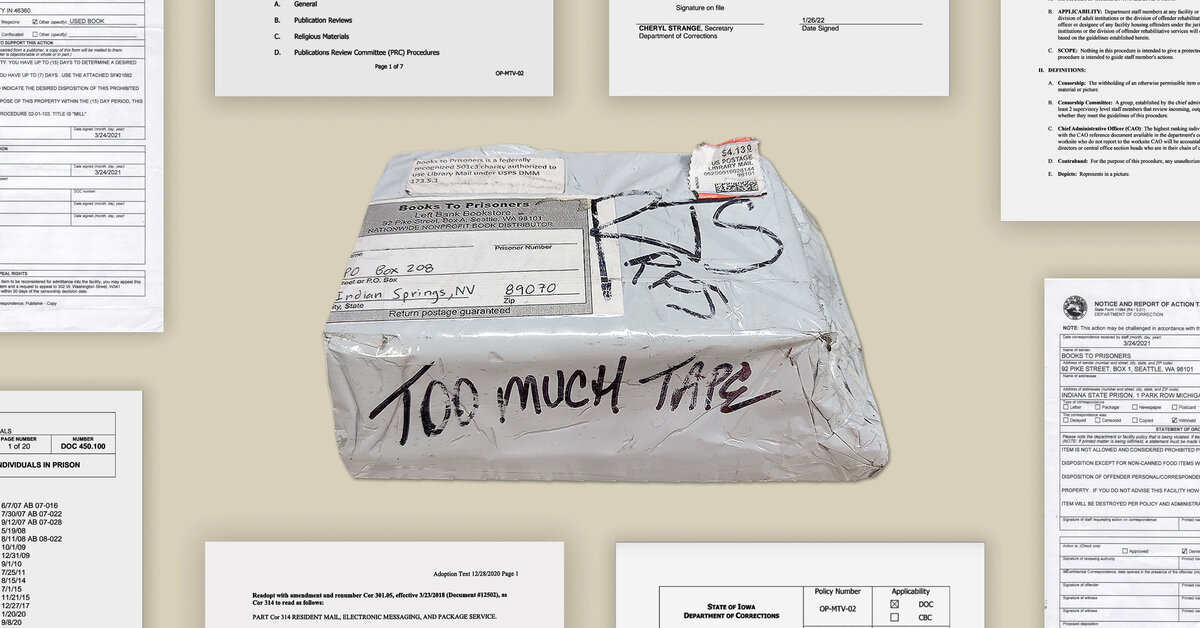
In addition to the tighter rules about who can send books inside, books-to-prisoner programs said many states are being stricter in their screening process. The programs have had packages rejected because the wrapping had too much tape. Facilities in some states also refused packages because they were wrapped in brown butcher paper instead of white.
“It underscores how much these systems get to set their own rules, and how little oversight there is to stop these bizarre, bewildering and overreaching policies,” said Michelle Dillon, with Books to Prisoners in Seattle, which has been sending books to incarcerated people across the country for 50 years.
Jennifer Carroll, is an expert in drug use and public health and former science to action coordinator for the CDC Foundation’s Overdose Response Strategy program. She said these book policies aren’t effective at curbing drug overdoses. Instead, she advises prison officials to invest in medication assisted treatment (like methadone) and ensuring access to naloxone, which can save a person who has overdosed.
“These are evidence-based medications. We know from countless studies that they reduce the risk of death across the board,” she said. In contrast, she said, there is little evidence that limiting book access will help save lives. She believes that books might actually be one way to fight addiction by boosting mental health. She said books can help people explore the difficulties they face or distract them from the dreary conditions of prison.
Books, Carroll said, foster a “sense that there is life that continues, that there is a curious and interesting and welcoming place for them to return to after their release.”