

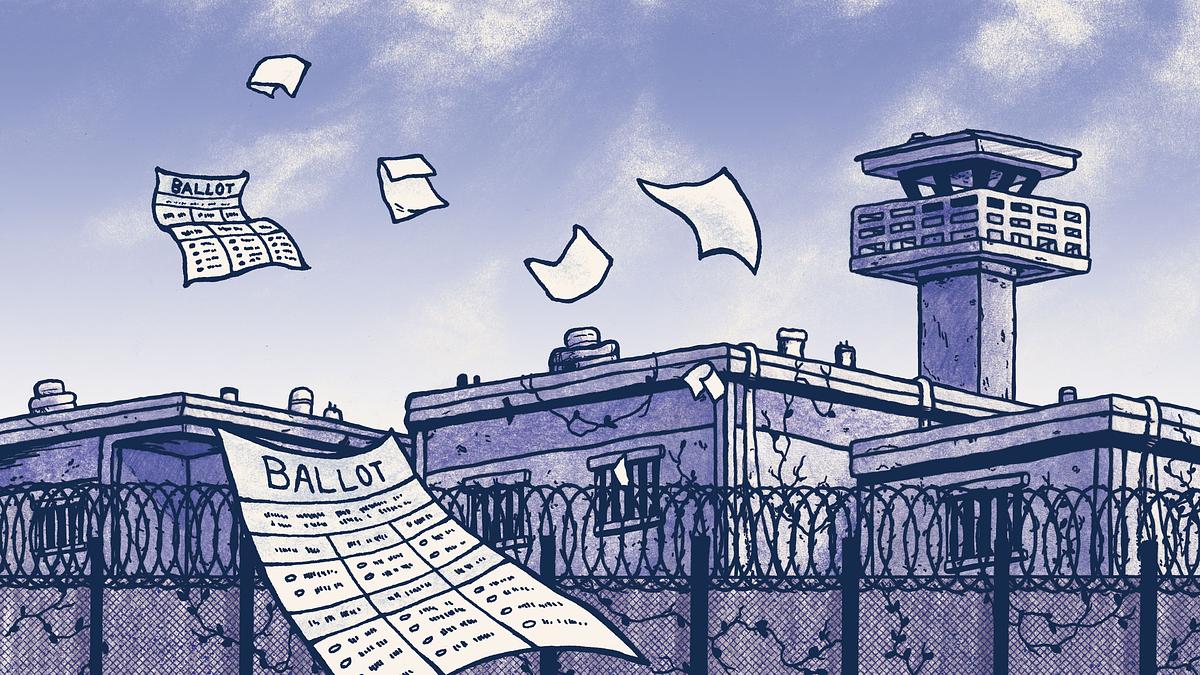
A new Mississippi law clarifies that some people held in jail or prison may vote in elections, but widespread confusion and a tangle of paperwork will likely continue to block many of them from casting ballots.
The state permanently disenfranchises people convicted of crimes that fall into 22 broad criminal categories. However, people convicted of any other crimes remain eligible to vote. But among those incarcerated people who have not had their voting rights legally taken away, Attorney General Lynn Fitch’s office suggested several years ago that state law allows only those who happen to be incarcerated outside their county of residence to cast an absentee ballot.
Under that interpretation of the law, a person who lives in Jackson and was arrested and sent to the local Hinds County jail could not cast an absentee ballot, even if they’d never been convicted of a disenfranchising crime in the past. But if authorities transferred that person to a jail in a different county, they would become eligible to cast an absentee ballot.
In their legislative session this year, state lawmakers approved the addition of a new absentee voting excuse that fixes this loophole, ending a system that blocked some otherwise legally eligible voters in jail or prison from voting based only on which side of a county line they find themselves.
“We’re disenfranchising people with no reason to do so, and we shouldn’t be doing that,” said state Sen. Jeremy England, speaking in favor of the measure during a legislative debate on the bill earlier this year. England, a Republican from the Gulf Coast area, chairs the state Senate’s elections committee and ushered the bill through the Senate.
Civil rights advocates who have conducted voter registration outreach in jails and prisons say that while the new legislation was needed, practical difficulties and common misunderstandings will continue to limit the ability of eligible voters in prison to actually cast a ballot.
“There is a real intimidating array of logistical issues,” said Paloma Wu, a civil rights attorney with the Mississippi Center for Justice. “We are extremely skeptical that people will in any volume be able to take advantage of this.”
Obstacles include mail delays within prisons and jails, in addition to a widespread but mistaken belief that all people with felony convictions are barred from voting in Mississippi.
The Legislature’s approval of a new absentee voting reason for eligible incarcerated people comes even as some state senators blocked a more sweeping attempt backed by the state House of Representatives to overhaul Missisisppi’s felony disenfranchisement laws and restore voting rights to thousands of people with nonviolent felony convictions.
That means Mississippi remains a study in sharp contrasts.
For some people with felony convictions, Mississippi is, legally speaking, among the most lenient states around ballot access, with some felony convictions never triggering a loss of voting rights at all. Nationally, most people in county jails are legally able to cast ballots while detained, but only a few states — Mississippi among them — allow anyone to cast a ballot from a state prison.
There are currently about 19,000 people held in Mississippi state prison custody, and thousands more held in local jails, but there’s no clear way to determine how many of those people can still vote. Mississippi court records do show that the majority of people convicted of state felony charges in the last 30 years remained eligible to cast a ballot.
For other people, Mississippi’s disenfranchisement system is one of the nation’s most punitive and unforgiving, with 22 categories of felony convictions stripping voting rights from someone for life, including a range of violent and nonviolent crimes.
Murder and rape convictions, for example, will permanently disenfranchise someone. But so will convictions for bad check writing, felony shoplifting and possession of counterfeit currency.
The distinctions can be confusing. Grand larceny convictions are disenfranchising, but burglary convictions are not.
Among those with burglary convictions is Tony Qualls from the Mississippi Delta.
This past legislative session, lawmakers agreed to restore voting rights to Qualls. Gov. Tate Reeves, a second-term Republican, vetoed the bill without explanation.
Qualls, however, never actually lost his voting rights. His three felony convictions are all for burglary, which is not a disenfranchising crime, according to a list of such crimes maintained by the Mississippi secretary of state. Qualls also does not appear on a list of disenfranchised voters provided to The Marshall Project – Jackson by the secretary of state’s office.


Several voting rights experts in Mississippi said they believe Qualls remains eligible to vote and cast a ballot regardless of the governor’s veto. They also said state leaders, county election officials and people with felony convictions have often shown confusion about how the state’s felony disenfranchisement laws work and who remains eligible to vote.
A spokesperson for Reeves did not respond to questions from The Marshall Project – Jackson about the governor’s veto.
Qualls could not be reached for contact.
This isn’t the first time lawmakers have tried to give voting rights back to someone who never lost them.
A review of suffrage legislation by The Marshall Project – Jackson identified that of 206 successful suffrage restoration bills passed since 1997, at least four were for people who didn’t actually need their voting rights restored.
One man was convicted of burglary in 1978 and committed no further crimes, only for the Legislature to approve an unneeded suffrage restoration bill on his behalf in 2006, a 28-year-long misunderstanding.
Among the 288 unsuccessful suffrage restoration bills introduced since 1997, 15 were filed on behalf of people who never lost the right to vote. One person had a bill introduced twice on their behalf, even though their felony conviction did not occur in Mississippi but in another state, and such out-of-state convictions don’t impact Mississippi voting rights.
If state lawmakers and governors are confused, it’s no surprise then that incarcerated people often are as well.
“They all think they can’t vote because they have a felony conviction,” said Cynetra Freeman, a reentry services provider who has conducted voter registration drives in county jails and state prisons.
Freeman was previously incarcerated on a drug conviction, but never lost the right to vote. She never tried to cast a ballot and didn’t realize she was eligible to vote until much later.
Local election officials have almost sole power over voter registration and absentee voting, but sometimes they don’t know the laws much better. Freeman and Wu both said registration applications by eligible people incarcerated by the state have been sometimes rejected by local elections officials for unclear reasons.
“Circuit clerk education is a big thing that is needed so that they know that there are people who are eligible to register and vote in Mississippi prisons and jails,” Wu said.
Some clerks say they are following the law and will make sure they heed the new absentee voting rules for people in jail and prison.
“We never didn’t let them vote if they were still able to vote,” said Rankin County Circuit Clerk Michelle Adcock.
Even when someone knows they are eligible to vote and plans to use the newly created absentee voting excuse to do so, serious hurdles remain.
This year, absentee ballot applications must be available beginning on Sept. 6, with absentee ballots themselves not available until Sept. 23. Mailed absentee ballots must be received by Election Day (Nov. 5). That gives incarcerated voters 61 days to send and receive as many as three different documents through the mail, while also obtaining services from a notary twice.
“I think it’s a real question if all that can be accomplished within the statutory deadline,” Wu said.
To cast an absentee ballot by mail, here’s the detailed process an incarcerated voter must go through:
-
Request an absentee ballot application from the circuit clerk of the county where the voter is registered. This can be done in writing or by phone, but the applications cannot be accessed over the internet. They must be mailed by the circuit clerk to an eligible voter upon request.
-
Once the application has been received, the voter must complete the application, have it notarized and mail the application back to the county circuit clerk. Voters with a legally recognized disability can use a witness instead of a notary.
-
If confirmed to be eligible, the clerk then mails an absentee ballot to the voter. The voter must complete the ballot, seal it, have the sealed ballot notarized and mail it back to the circuit clerk.
There’s ample room for delays throughout this process.
“Sometimes the mail rooms in these facilities take forever to mail something out, and by the time the clerk gets it, it’s past the deadline,” said Freeman. “That is a big issue.”
The Mississippi Department of Corrections did not respond to questions from The Marshall Project – Jackson about voting procedures for eligible state-incarcerated people.
Even if the state prisons are processing mail quickly, delays by the postal service can also occur. Such delays have raised national concerns about possible impacts on voting.
“We have a major problem with the mail in general,” said Adcock, the Rankin County circuit clerk.
Mississippi’s failure to meaningfully reduce these logistical hurdles comes as at least one other state is lifting them.
Colorado does not allow people held in state prisons to vote, but pre-trial detainees in county jails can vote. This year, the state will require the creation of voting centers in county jails to facilitate voting by those pre-trial detainees.
Colorado is the first state in the nation to require such centers.