

Filed
12:00 p.m. EDT
08.02.2025
New York’s controversy over scanning mail in prisons reflects a national debate involving security and privacy.
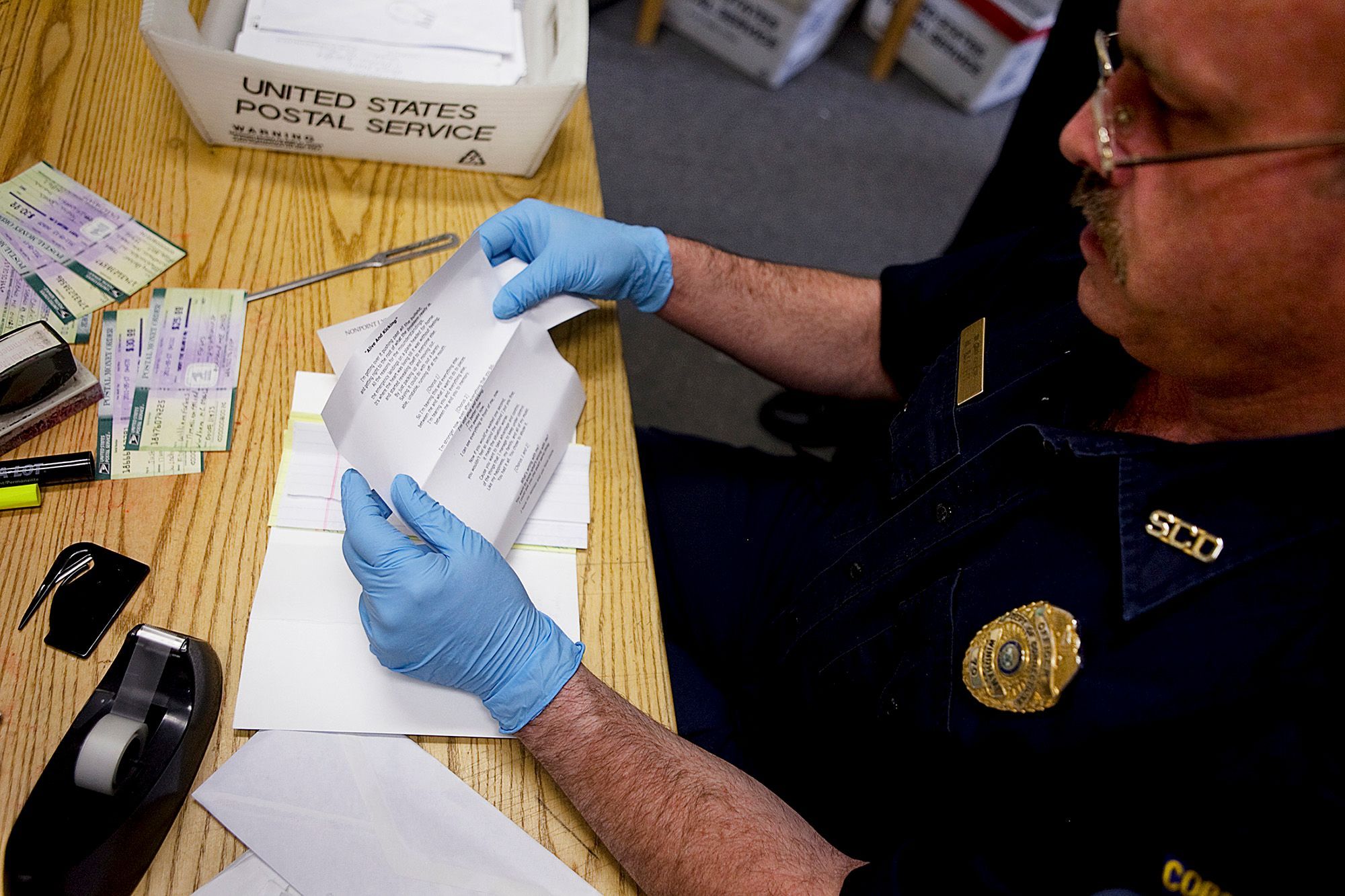
Corrections officer Mike Barrett searches an envelope for contraband in the mail room of Maine Correctional Center, in Windham, Maine, in 2011.
This is The Marshall Project’s Closing Argument newsletter, a weekly deep dive into a key criminal justice issue. Want this delivered to your inbox? Sign up for future newsletters.
Last week, we took a look at the lingering effects of the New York correctional officers’ wildcat strike, which ended in March. To bring officers back to work, one of the demands that the state met was to introduce scanners for legal mail, intended to help prevent drugs from entering prisons. Striking guards argued their safety was at risk by both exposure to drugs, and by prisoners acting erratically after using drugs, according to the Times Union.
By late July, the scanners were already in use at 36 of the state’s 42 prisons, and will soon be in all facilities, according to a Department of Corrections and Community Supervision spokesperson. The department has so far been able to bypass the formal rulemaking process due to the emergency conditions of the strike, but it is now proposing to make the policy permanent.
Those moves have ignited controversy, and reflect a long-running debate in prison systems across the country between the need for security measures and respect for incarcerated people’s access to mail as a vital avenue to connect with families and legal help.
When prison administrators, lawmakers and advocates talk about “scanning” incoming mail, there are two separate things they can mean. One is the digitization of mail by copying the contents into an electronic format so prisoners can read it on a tablet. The other meaning — more accurately described as screening, as in the case of New York’s new system — is technology to physically test mail for signs that it has been soaked in, or otherwise contaminated with illicit substances. Incarcerated people and advocates have expressed concerns with both kinds of scanning, having to do with privacy, delays and the sentimental value of handwritten letters and physical keepsakes.
In New York, regular mail from family and friends was already photocopied before the strike. The new scanners are a trickier proposition, because legal mail is protected by attorney-client privilege.
Much like field drug tests, the scanners aren’t always accurate. Some advocates and incarcerated people say the new machines, which were purchased through a $4.4 million contract with “contraband detection solutions” company RaySecur Inc., are incorrectly flagging contraband-free mail. When a piece of legal mail is flagged, the corrections department’s proposed rule allows mailroom staff to withhold the mail without confirming it actually contains contraband. A coalition of legal organizations with clients in New York prisons outlined their concerns in a recent letter to the agency.
“What DOCCS appears to be doing is laying the groundwork for these machines to be the final determination,” said Antony Gemmell, supervising attorney with The Legal Aid Society’s Prisoners’ Rights Project and co-author of the letter. “They’re using this technology beyond its intended scope.”
RaySecur describes its scanners as a tool to reduce the volume of mail that requires further inspection by staff, not a way to eliminate that step.
Jeremy Zielinski, who is incarcerated at Woodbourne Correctional Facility, said he was surprised when a letter from the Second Circuit Court of Appeals was recently blocked by the mailroom. “It may make the situation more dangerous if they’re relying too heavily on tech that doesn’t work right, potentially decreasing security by becoming lax with their ordinary inspection routines,” he said of guards.
Civil rights attorney Amy Jane Agnew, who has clients who have died following overdoses in New York prisons, supports scanning the mail if it saves even one life, and isn’t bothered by having to resend the occasional letter. But, she contends that staff smuggling narcotics into prisons is a bigger problem than drugs coming through the U.S. mail. “The best approach is putting drug dogs in the officer’s locker rooms, because that’s where it’s coming in.”
This debate is part of a bigger discussion playing out in states across the country and in the federal government. A recently introduced bipartisan Senate bill would mandate that the Federal Bureau of Prisons perform both kinds of scanning at its prisons and jails systemwide. The bill would require the agency to digitally reproduce all mail within 24 hours for access on a tablet, and then to deliver the physical mail within 30 days, so long as it is determined to be free from drug contamination during screening.
Advocates for incarcerated people argue that digitizing personal mail invades privacy and further chips away at crucial connections with loved ones. And legal mail is trickier still, given confidentiality concerns. But mail is a real avenue for drugs in prisons, and corrections unions across the country have expressed concern that handling contaminated mail poses serious and even fatal risks to staff.
Last year, correctional officer Marc Fisher died at a federal prison in Merced County, California, after opening a letter laced with narcotics being passed off as legal mail. Three people involved in the mail scheme — including one incarcerated at the prison — were ultimately arrested and charged. The letter was found presumptively positive for fentanyl, synthetic marijuana and amphetamines. Fisher reported severe symptoms within minutes of exposure to the mail. His autopsy found that he died of natural causes from a heart attack, according to a government filing, but also that “the circumstances of death suggest external influences.”
The scientific consensus on brief or incidental drug exposure from things like handling drug-soaked mail is that it is extremely unlikely to cause a fatal overdose. Still, it’s not uncommon for police and corrections officers to experience odd symptoms after handling (or believing they have handled) illicit substances. Earlier this year in New York, a State Police hazardous materials team investigated the cause of guards fainting and exhibiting slurred speech after an alleged exposure to contraband. The team found no evidence of “toxic substances or drugs that might be responsible for the workers’ reactions.”
Just how much contraband is coming in through mailrooms is unclear. Available data is often spotty, if it’s tracked at all, and is collected by corrections agencies themselves, causing some to question its accuracy. It’s also not always clear that scanning mail actually helps reduce the flow of drugs: In the months after the Missouri Department of Corrections started digitizing mail, overdose deaths actually increased. A New Jersey correctional union representative, on the other hand, said digitizing mail led to a 50% decrease in overdose rates in state prisons.
In any event, both kinds of scanning are catching on quickly. In Tennessee, a pilot program to digitize mail at three women’s facilities began on Aug. 1, with incoming personal mail to be sent to Maryland for scanning. In Illinois, there’s been a legislative push to ban most physical mail entering prisons, and the state department of corrections is in the process of deciding how to use digitizing technology it purchased last fall.
The technology used to screen mail is also evolving rapidly, and is diverse across prison systems as different vendors seek to win contracts. While New York and Hawaii are using “T-ray” imaging technology, pitched as more sensitive and accurate than X-ray technology, others are using “hyperspectral imaging.” And earlier this year, the Virginia corrections department became the first in the world to pilot a CT-based scan (like the ones used in medicine) combined with AI machine-learning algorithms.