

Roughly 13 minutes into “The Alabama Solution,” a revelatory new documentary about the long-simmering humanitarian crisis in Alabama’s state prisons, filmmakers Andrew Jarecki and Charlotte Kaufman got a tip about an incarcerated man who had been beaten so badly he was taken to the ICU at an outside hospital.
By the time Jarecki and Kaufman arrive, Steven Davis was dead.
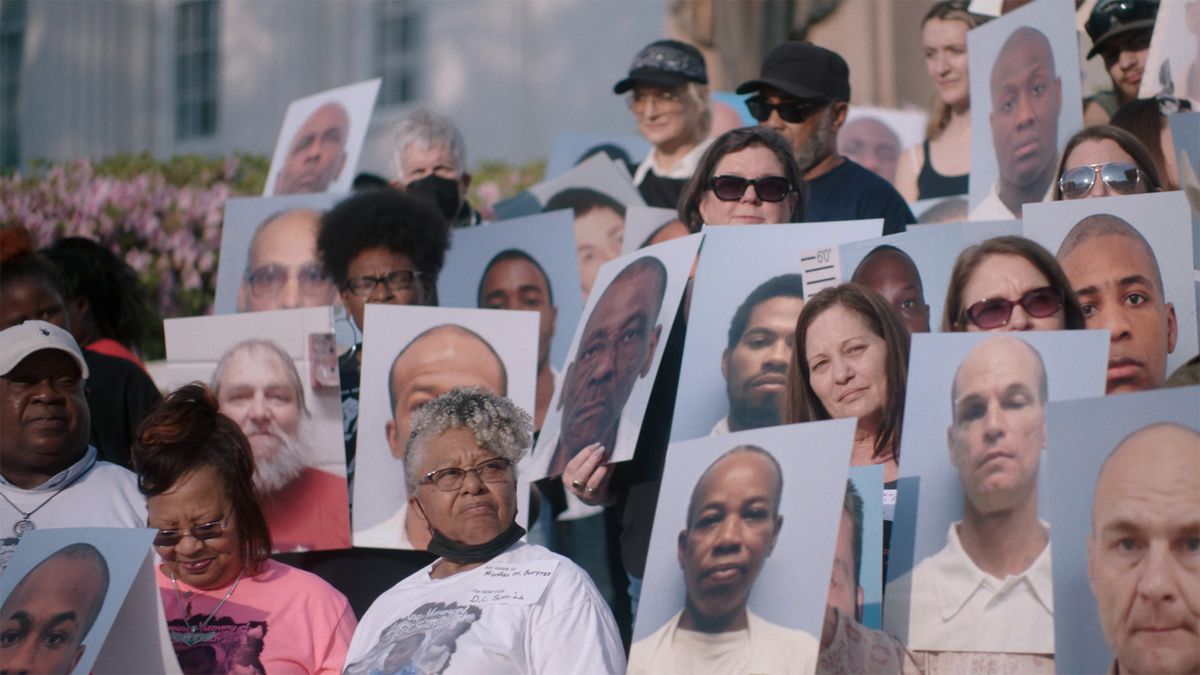
Uncovering that Davis had been killed by a guard is only part of the focus of the documentary, which is now streaming on HBO Max. Death is increasingly common in Alabama’s prisons. Since 2019, roughly 1,380 incarcerated people have died or been killed while in custody of the state. The documentary — which features footage shot on cell phones by several incarcerated men — zooms out to explore why, despite federal inquiry and a lawsuit brought by the U.S. Justice Department, officers are still able to neglect, harm and kill incarcerated people with seeming impunity.
The answers that Kaufman and Jarecki, who is a donor to and board member of The Marshall Project, find might be familiar to those who keep a close eye on America’s prisons. The facilities are overcrowded and understaffed, parole is almost nonexistent, drug use is rampant, racial disparities abound, lawmakers recite tough-on-crime platitudes, incarcerated people work for free, and little is done to mitigate these circumstances. Perhaps less familiar are the lengths Alabama officials go in the film to cover up the disorder and state lawmakers’ callous disregard for incarcerated lives when presented with the troubling facts.
The filmmakers were able to capture the crisis in graphic detail thanks to the efforts of a group of incarcerated men. Robert Earl Council, Melvin Ray, and Raoul Poole risked their lives to take viewers inside Alabama’s prisons using cellphones they purchased through the prison’s black market. The men documented the disarray, drug use and death in real time, establishing a damning counternarrative to the department’s insistence that they do not need federal intervention and can instead address “the Alabama problem with an Alabama solution.”
“It’s a continuous cycle of violence, lack of accountability,” Ray said in the documentary. “And without us being able to inform society about what’s happening — these incidents are not even reported.”
We’ve collected five key takeaways from the film, with additional context from The Marshall Project’s reporting on conditions behind bars across the United States.
1. Alabama’s prisons have reached a “humanitarian crisis level,” as one of the men featured described it, with unchecked violence and deaths. Scrutiny from the U.S. Department of Justice has failed to improve conditions.
For years, the public has had no way of knowing how many people had died while incarcerated in Alabama. The Department of Justice concluded in a 2020 report that the state’s Department of Corrections was failing to adequately account for deaths in its prisons. Officials left several homicides out of the official reporting, listed some deaths as “natural” when violence was the real cause, and didn’t report dozens of deaths at all, the investigators found.
“ADOC cannot address and prevent recurring harmful situations if it is unaware of the scope of the problems within Alabama’s prisons,” federal investigators wrote.
The deaths have not abated, despite a legislative mandate to publish quarterly death reports that include high-level autopsy findings. The filmmakers found that the death rate had more than doubled since 2019, with 277 deaths last year.
Incomplete or inaccurate death reporting is common in America’s prisons. The Deaths in Custody Reporting Act requires prison officials to report every death to the federal Justice Department. But The Marshall Project found that few states provide such information, and despite a provision allowing the agency to withhold funding from noncompliant facilities, state prison systems are never held accountable for their failures.
2. Drug use is rampant in prison, and so are overdose deaths. Alabama has failed to stem the flow of illicit substances and doesn’t provide adequate substance abuse treatment to incarcerated people who need it.
Overdoses are the major contributor to the rising death rate in Alabama prisons, the filmmakers found. They identified nine deaths in 2019 related to drugs. In 2023, roughly 122 people died from drug-related causes.
Throughout the film, incarcerated men are shown “nodding out,” meaning they were asleep while standing or sitting upright, a hallmark feature of opioid abuse.
Drug treatment is rare in Alabama prisons. Fewer than 5% of the people incarcerated in the state participated in drug treatment programs last year, down from 20% in 2010, according to Department of Corrections reports.
In Alabama and other states, officers supplement their low wages with earnings from drug sales. Midway through the documentary, Stacy George, a former Alabama correctional officer, posits that the system turns a blind eye to drug smuggling because of understaffing. If a guard was caught bringing drugs inside, he said, officials would have no choice but to fire him, exacerbating the shortage.
“There’s no checkpoints out the front. There’s no dogs anymore,” George said. “So they’re not even really paying attention.”
3. The emotional and financial cost of Alabama’s prison violence is staggering. Families struggle for years to get answers about the deaths, and the state has spent millions on lawyers and settlements.
In August, Alabama paid Sondra Ray $250,000 to settle a lawsuit over the beating death of her son Steven Davis.
The documentary, in part, follows Ray’s search for the truth. At first, the prison had told her that Davis had died while being subdued after charging at guards with a homemade weapon. That account is quickly challenged in the film by a phone call from an unidentified officer, who offers Ray condolences before telling her what happened.
“I wanted to tell you, your son was beaten to death by an officer,” he said. “That was a murder.”
Over the last five years, Alabama has spent more than $53 million defending and settling lawsuits, and protecting officers accused of misconduct, the filmmakers found. In Ray’s case alone, the state spent an additional $393,000 on 11 different attorneys to defend the corrections officers named in the lawsuit, the Alabama Appleseed reported.
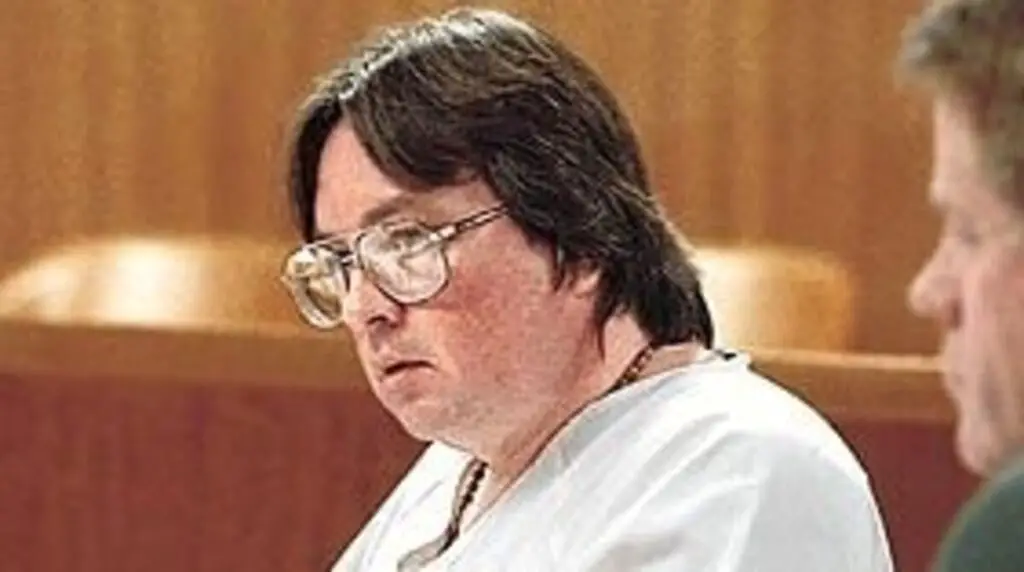
The state ultimately concluded that Roderick Gadson, the guard who killed Davis, was justified in his use of force. He was promoted twice after the killing.
Officer accountability is rare in Alabama and across the country. In New York, Marshall Project reporters found that the state rarely fired officers accused of using excessive force on prisoners. Often, the guards colluded to cover up their wrongdoing by lying to investigators or falsifying reports.
4. Incarcerated people have risked their lives to expose conditions behind bars, filming the chaos inside on cell phones furnished by corrections officers.
The men at the center of the film have spent a large share of their incarceration advocating for change from the inside out. They credit their activism to a self-directed course of study organized by prisoners who were active in freedom movements during the civil rights era. In the study groups, the men learned about their constitutional and legal rights.
“People say it’s a law class,” Council said. “It was so much more than just a law class. It was like a [rite] of passage of coming into manhood.”
Prisons are state institutions, Ray says early in the film, but it’s the only institution that the public and the media have no access to. For years, the men attempted to expose the disorder inside by filing grievances, hoping their cases would make it to court. Eventually, they founded the Free Alabama Movement and began rallying family members to push for prison reforms from the outside.
In 2016, the federal Justice Department took notice and began an official investigation into prison conditions. In 2020, the department filed a lawsuit alleging widespread constitutional violations, including rampant violence, homicide and sexual assault. In response, Alabama officials have downplayed the systemic issues, resisting a federal takeover.
“There’s got to be an Alabama solution,” said Alabama Gov. Kay Ivey at a press conference captured in the documentary. “We cannot tolerate the alternative, which is having the DOJ take it over, turn folks loose. It’s our problem. We gotta own it. We gotta fix it.”
Throughout the documentary, Ray and Council use contraband cell phones to make a direct appeal to the public, offering unprecedented access to the prisons. Their phones have become the essential tool in their fight against the state. Without a phone, they argue, there would be no way to show just how much conditions inside have deteriorated. As officials get more sophisticated in targeting and restricting the devices, the men worry it’s only a matter of time before their signal won’t get through to the outside.
5. Alabama’s economy is powered in part by incarcerated people, who are employed by corporations in industries such as poultry processing. Many also provide services like sanitation and groundskeeping for the state, often working alongside the public.
Alabama’s incarcerated workers produce $450 million in goods and services every year, the filmmakers reported. The men and women work under the threat of disciplinary action, such as solitary confinement, if they refuse to participate. Most are paid less than minimum wage, if they are compensated at all.
The fact that the American prison system’s roots extend all the way back to slavery has made its way from academic circles into popular culture. Ray and Council draw a direct line between Alabama’s Confederate history and current prisoners, whose labor enriches corporations and the state.
“We always understood that our labor is what this is all about,” Ray said as the film explores the impetus for a 2022 work stoppage across all of Alabama’s prisons.
For several weeks, incarcerated people refused to work inside the prisons, demanding the federal Justice Department take over the system to end the “systematic denial of human and dignity rights.”
Strikes are a cornerstone of prison activism. The Alabama work stoppage triggered a class-action lawsuit, alongside several labor unions, accusing the state and corporations of practicing modern-day slavery. The court case builds on several previous efforts. In 2018, incarcerated organizers, including members of the Free Alabama Movement, called for a general strike in prisons across the country. Organizers called the strike to protest the Thirteenth Amendment’s slavery exception, which abolishes unpaid labor except as a condition of incarceration.
The legacy of slavery is more pronounced in Southern prisons, where many incarcerated people work on farms. The Associated Press traced nearly $200 million dollars in sales of agricultural products and livestock over a period of six years to prison labor across the country. The figure is likely an underestimate, the reporters noted. Their investigation uncovered a sprawling shadow workforce of the incarcerated that produces goods and services sold by major corporations such as McDonald’s and Walmart.