

Federal agents began immigration enforcement operations in metro New Orleans on Wednesday morning, as part of what the Department of Homeland Security is now calling Operation Catahoula Crunch (previously dubbed Swamp Sweep). Across the city there were reports of agents gathering, arrests at home improvement stores, and closed businesses in immigrant-heavy neighborhoods — scenes reminiscent of recent blitzes in Los Angeles, Chicago, and Charlotte, North Carolina.
For some, New Orleans may not seem an obvious next location. The city is home to only about 27,000 foreign-born people, according to U.S. Census data, well below Charlotte’s 150,000 and Los Angeles’ 1.5 million. Metro New Orleans is about 10% foreign-born, below the national average of 14.3%.
But in Louisiana, the Trump administration finds a unique combination of recent legal changes, enforcement-friendly politics and a large immigration detention infrastructure that could make the operation smoother than other efforts. Louisiana is also the first location where this type of crackdown is taking place under a state law that makes it a crime — even for local officials and police — to interfere with federal law enforcement.
Administration officials like top Border Patrol commander Gregory Bovino have generally been coy about how they pick locations, citing “intelligence” and telling reporters they wouldn’t “telegraph potential operations.” For many New Orleans area leaders, the selection looks like a choice made for political theater. President Donald Trump has relished any opportunity to flex federal muscle in locales where his politics are unpopular, and New Orleans is a historic Democratic stronghold.
“What we are seeing unfold in our community is not public safety; it is a political stunt wrapped in badges, armored vehicles, and military uniforms,” U.S. Rep. Troy Carter, a Democrat who represents most of the New Orleans metro area, said in a statement on Tuesday.
As a matter of timing, the most obvious advantage for the administration came two days before federal immigration agents began staging for operations in southern Louisiana, when a federal judge formally ended New Orleans’ nearly 13-year-old policing consent decree. For most of that time, the court-monitored agreement tightly regulated how the New Orleans Police Department could engage with immigrants, banning officers from asking about immigration status, compiling records related to immigration or participating in civil immigration enforcement. The consent decree made the city a de facto “sanctuary city” in many ways, but by court order, rather than city ordinance as in Chicago and Los Angeles.
In announcing the new operation on Wednesday, Department of Homeland Security Assistant Secretary Tricia McLaughlin said agents are targeting violent criminals who were released after arrest due to “sanctuary policies that force local authorities to ignore U.S. Immigration and Customs Enforcement arrest detainers.”
City police Superintendent Anne Kirkpatrick has said that officers will not be participating in removals, raids or deportations. But she has also acknowledged that her department will cooperate with enforcement efforts. “They’re coming, so I am going to be a partner,” Kirkpatrick said last month. On Wednesday, a spokesperson for the department said it had no updates on the operation.
It’s not yet clear what assistance federal agents might request from local police, but in general terms, such partnerships are essential for large-scale enforcement operations. “Rounding up and disappearing as many people as possible is incredibly time and labor-intensive, which is why this administration is relying in part on local police and sheriffs to act as gears in Trump’s deportation machine,” said Heidi Altman, vice president of policy at the National Immigration Law Center.
While New Orleans now has fewer legal barriers to cooperation, immigration advocates on the ground say the priorities of local officials will still shape what comes next.
Rachel Taber, an organizer with Unión Migrante, a local immigrant rights advocacy group, said she was not yet aware of any explicit collaborations, like city police asking about immigration status at traffic stops. Taber is cautiously optimistic that the department will only cooperate with federal enforcement to the bare minimum required. “NOPD I don’t believe has the political will to do ICE’s work, nor the bandwidth, nor the resources, nor the finances,” she said.
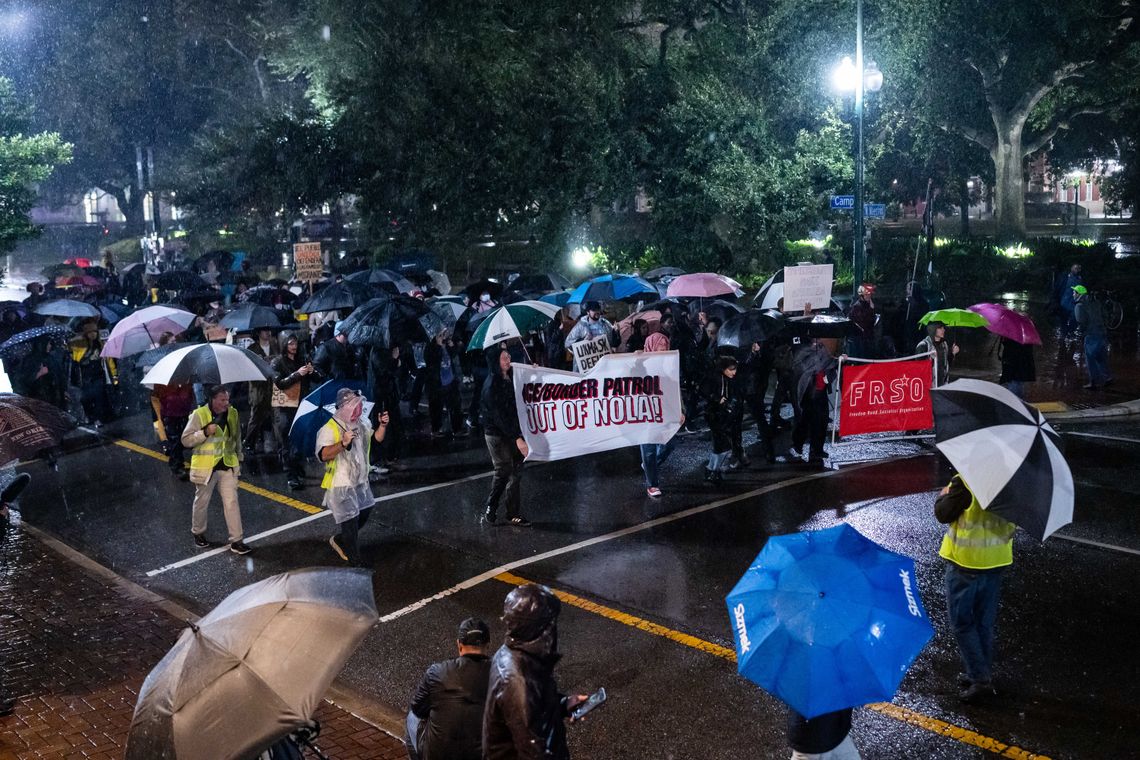
A protest in New Orleans on Monday, Dec. 1, 2025, amid reports of an impending federal immigration operation.
Taber is much more concerned about federal-local cooperation in surrounding parishes, which are more conservative. The Jefferson Parish Sheriff’s Office, in charge of the largest New Orleans suburbs, has a long history of working with federal immigration enforcement. That includes honoring the kinds of jail detainer requests that the Orleans Parish sheriff frequently has not, due to a 2013 settlement in a civil rights case. Detainers allow local officials to hold people in jail for immigration agents, even without local criminal charges.


Within Jefferson Parish lies the city of Kenner, where roughly 30% of residents are Hispanic, according to Census data. In March, the city became the second of at least 23 local agencies to enter into a 287(g) agreement with ICE this year, according to The Times-Picayune. These agreements allow ICE-trained local officers to perform certain immigration processing functions while booking someone into jail, essentially turning routine arrests into potential immigration encounters.
Detainer requests processed by Kenner police have increased more than sixfold this year, according to reporting from Verite and the Gulf States Newsroom. Kenner Police Chief Keith Conley has routinely defended cooperation with immigration enforcement, arguing Wednesday in remarks to The New York Times that “the community, the city as a whole, they support it.” He’s also been accused of racial profiling. In November, Conley said he asked ICE to join in a police raid at a local boat launch “because we knew there was going to be a large amount of Hispanics out there.” Neither Kenner police nor the Jefferson Parish Sheriff’s Office responded to a request for comment.
At the state level, the Trump administration has the full-throated support of Gov. Jeff Landry and state Attorney General Liz Murrill. Both are Republicans. Murrill warned this week that a new state law could lead to arrests for private citizens or public officials who get in the way of enforcement activity. That’s because while a number of states have passed pro-enforcement laws in recent months, legislation enacted in Louisiana as of Aug. 1 has drawn attention from legal observers for the broad scope of its language.
The statute criminalizes any action that could “hinder, delay, prevent, or otherwise interfere with” federal immigration enforcement. It also exposes public employees, including police officers, to felony charges of “malfeasance in office” using similar language.
Alanah Odoms, executive director of the American Civil Liberties Union of Louisiana, warned that the law “does not allow anyone to safely and confidently know what they can or cannot do to run afoul of this law and face criminal charges.” She noted that the bill’s own sponsor acknowledged that providing humanitarian aid to an unauthorized immigrant could even theoretically be criminalized, depending on a district attorney’s interpretation.
While questions remain about how the revised statute will be used, there’s a much older state law that could affect enforcement operations, but which no one expects to be used for charges. State law bans facial coverings in public, and in theory, the kinds of masks federal agents have tended to wear during operations would violate it. The pre-Civil Rights Era law aimed at Ku Klux Klan activity was recodified in state law in 1999. There are carve-outs for Halloween, religious and medical coverings — and of course, for Mardi Gras — but none for law enforcement.
To the extent that the Trump administration has explained its rationale for selecting the New Orleans area, crime has been the overwhelming answer. As early as September, Trump said that he’d send federal troops to the city to sort out its “crime problem.”
Historically, New Orleans has been one of the more dangerous cities in the country by almost any metric, but it’s in the midst of a dramatic — even historic — decrease in its violent crime rate. According to data from the AH Datalytics Real-Time Crime Index, violent crime in New Orleans has fallen by more than half since 2022, when increasing rates had much of the city on edge. As of June, there were fewer murders in the city than in any year since 1970.
However, Murrill, the attorney general, has argued that the city “has seen a high number of violent crimes committed by illegal aliens.” Her office did not respond to a request for data that would support this claim. Murrill has frequently cited the 2024 death of 43-year-old New Orleans tour guide Kristie Thibodeaux. One of the three teens who pleaded guilty in the case reportedly entered the U.S. illegally in 2019.
Jeff Asher, a New Orleans-based crime analyst and founder of AH Datalytics, said that violent crime by undocumented immigrants is “exceedingly rare” in New Orleans, while acknowledging that this fact doesn’t diminish the tragedy of incidents that have occurred. Asher said that he “wouldn’t expect any expansion of immigration enforcement locally to have much — if any — impact on the city’s crime rates.”
Research also routinely shows that immigrants are no more likely to commit crimes than native-born Americans. “If the administration’s actions were truly motivated by concerns over public safety, it would respect local control and partner with cities and rural counties experiencing spikes in crime,” said Nick Wilson, a gun policy expert with the progressive think tank Center for American Progress. Instead, Wilson said, “the Trump administration is cutting funding for law enforcement, crime intelligence tools, and proven prevention programs that have reduced crime in New Orleans and in cities across the country.”
For the federal government, geography eases some of the logistics of immigration enforcement. New Orleans sits at the center of one of the nation’s most expansive immigration detention ecosystems. Louisiana holds more detainees than any state besides Texas, and according to the state ACLU, at least 10 detention facilities are currently operating statewide.
That concentration of beds could simplify plans compared with efforts in places like Charlotte and Chicago, where many of those arrested wind up being bused or flown hundreds of miles to Louisiana or Texas — although many centers are already at or over capacity according to ISLA, a local immigration advocacy law center. New Orleans’ status as a major port city gives federal agencies a deeper operational footprint than in many inland metros. CBP already maintains personnel, vehicles and processing infrastructure that can be repurposed during the blitz.
Legal geography may matter as well. Louisiana falls under the jurisdiction of the 5th Circuit Court of Appeals, one of the most conservative federal appellate courts in the country and one that has generally shown a high level of deference to state authority in immigration matters.
Still, despite all these unique advantages, immigrant rights advocates say they trust in the resolve of the local community to look out for one another. Taber from Unión Migrante said the organization is training thousands of volunteers every week on how to safely and legally film enforcement activity to create oversight and networks for alerting immigrants about activity.
“The people of New Orleans don’t play,” Taber said. “We’re good people. But we defend our rights.”